Cats are incredibly good at hiding when something is wrong. By the time most owners notice a problem, it has often been building quietly for days. Dehydration is one of the most common and most overlooked health issues in domestic cats, and it rarely announces itself clearly.
The signs are subtle. But once you know what to look for, you can catch them early, test at home, and take action before the situation becomes serious.
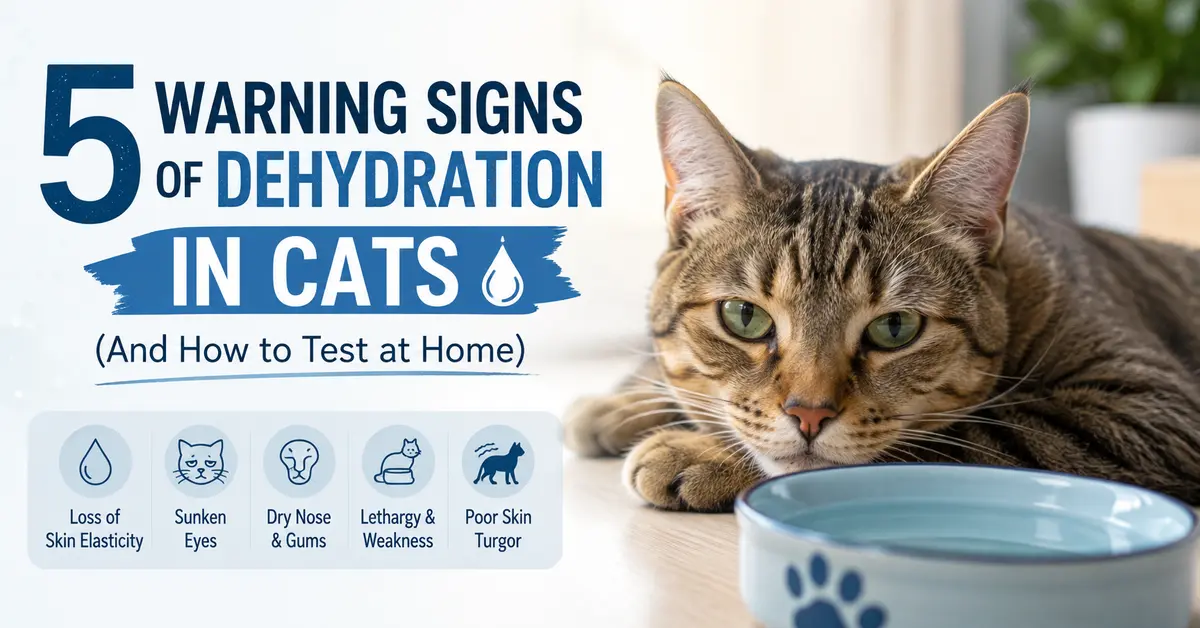
Here are the five warning signs every cat owner needs to know.
Healthy vs. Dehydrated Cat: Quick Comparison
| Sign | Healthy Cat | Dehydrated Cat |
| Gum Color | Pale Pink, Moist | Pale, White, or Dry |
| Skin Turgor Test | Snaps Back Immediately | Slow to return or Stays Tented |
| Eyes | Bright, Clear, and Ful | Sunken or Dull |
| Urination | Regular, Light-colored | Infrequent, Dark, Strong-smelling |
| Energy level | Active and Alert | Lethargic and Withdrawn |
| Mouthfeel | Moist and Slick | Tacky or Dry |
Why Cats Get Dehydrated So Easily
Cats have a naturally low thirst drive. This is rooted in their biology. Their wild ancestors obtained most of their fluid intake from prey rather than standing water sources. Domestic cats inherited this instinct, which means they do not feel the urge to drink water the way dogs or humans do.
Cats eating a purely dry food diet or kibble are at the highest risk. Dry food contains only 6 to 10% moisture. Without adequate fluid from food, a cat must drink significantly more water independently, something most cats simply will not do on their own.
Certain health conditions also increase dehydration risk. Chronic Kidney Disease, feline diabetes, vomiting, diarrhea, and feline heatstroke all cause fluid loss that the body struggles to replace quickly.
Warning Sign 1: Dry or Tacky Gums
This is the most reliable at-home indicator of dehydration in cats.
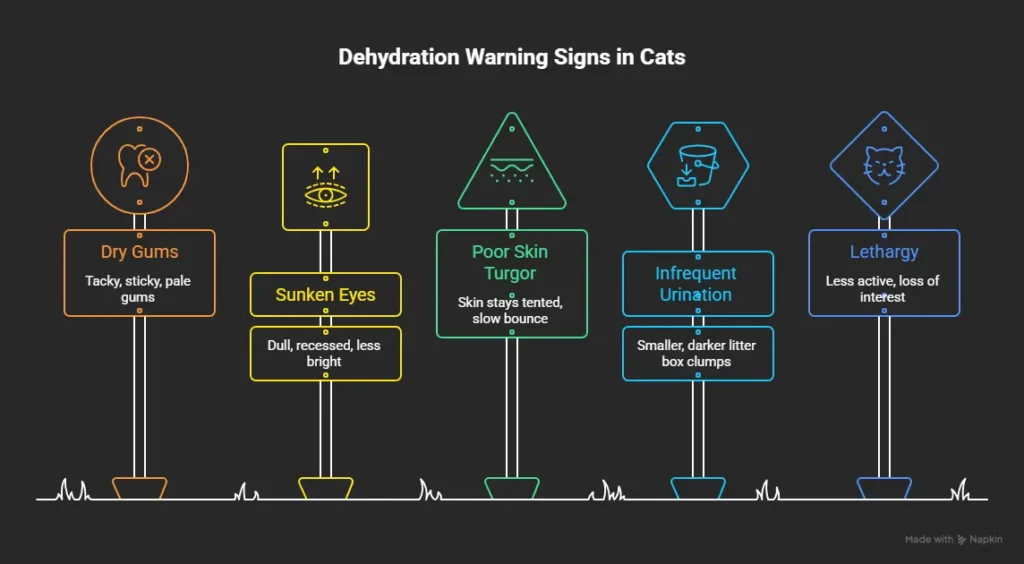
Healthy cat gums are pale pink, smooth, and moist to the touch. When a cat is dehydrated, the mucous membranes inside the mouth dry out. The gums feel tacky or sticky rather than slick. In severe cases they appear pale, white, or grayish.
How to Check Your Cat’s Gums at Home
Gently lift your cat’s upper lip and press one finger lightly against the gum line. Run your finger across the surface. Healthy gums feel like the inside of your own cheek. Dehydrated gums feel like dry rubber or slightly adhesive.
What Is Capillary Refill Time
While checking the gums, press your fingertip firmly against the gum for two seconds, then release. The area will briefly turn white from the pressure. Count how long it takes for the pink color to return.
In a healthy cat, color returns in under two seconds. A capillary refill time of more than two seconds indicates poor circulation and is a sign of moderate to severe dehydration. This requires immediate veterinary attention.
Warning Sign 2: Sunken or Dull Eyes
A well-hydrated cat has bright, clear, full-looking eyes. Dehydration causes the tissue around and behind the eyes to lose fluid, which makes the eyes appear sunken into the eye sockets.
Dehydrated cat eyes also lose their natural shine. They look dull, glassy, or slightly recessed compared to normal. This sign is more visible in moderate to severe dehydration and often appears alongside other symptoms rather than on its own.
If you notice your cat’s eyes looking sunken or less bright than usual, check the gums and perform the skin turgor test immediately.
Warning Sign 3: Skin That Does Not Bounce Back
The skin turgor test is the most well-known at-home hydration check for cats. It tests how quickly the skin returns to its normal position after being gently lifted.
How to Perform the Skin Turgor Test
Find the scruff of the neck or the loose skin between the shoulder blades. Gently pinch a small amount of skin, lift it slightly, and release it.
In a healthy, well-hydrated cat, the skin snaps back to its original position almost immediately.
In a dehydrated cat, the skin returns slowly or stays slightly tented for a second or two before flattening out.
One important note: this test is less reliable in older cats or cats that have lost significant weight, as their skin naturally has less elasticity regardless of hydration status. Use it alongside the gum check for a more accurate assessment.
Warning Sign 4: Infrequent Urination and Small Litter Box Clumps
Changes in your cat’s litter box habits are one of the earliest practical indicators of dehydration.
A well-hydrated cat produces regular, light-colored urine clumps in the litter box. A dehydrated cat urinates less frequently, and the clumps are noticeably smaller and darker. The urine may also have a stronger odor than usual due to a higher concentration.
If you are scooping the litter box daily, you are in a good position to notice these changes early. A reduction in litter box visits combined with darker urine is a clear signal that fluid intake has dropped below what the body needs.
Decreased urination over more than 24 hours, especially when combined with straining or crying near the litter box, requires urgent veterinary attention. This can indicate a urinary blockage, which is a medical emergency particularly in male cats.
Warning Sign 5: Lethargy and Loss of Interest in Food
A dehydrated cat withdraws. They move less, sleep more than usual, and show reduced interest in food, play, and interaction. This behavioral shift is easy to miss because cats naturally sleep a lot.
The key is changing from their normal pattern. If your cat is noticeably less active than their usual baseline, less interested in meals, or reluctant to engage when they normally would, dehydration may be the cause.
Feline constipation is also closely linked to dehydration. Without adequate fluid, the digestive system slows and stool becomes hard and difficult to pass. A cat straining in the litter box without producing anything, or producing very dry and small stools, is showing a clear sign of insufficient fluid intake.
What Causes Dehydration in Cats
Several conditions and circumstances lead to dehydration in cats:
- Eating only dry kibble with no wet food supplementation
- Vomiting or diarrhea that causes rapid fluid and electrolyte loss
- Chronic Kidney Disease or renal disease, where the kidneys lose the ability to retain water efficiently
- Feline diabetes, which causes excessive urination and fluid loss
- Feline heatstroke, particularly in summer months or in poorly ventilated spaces
- Reduced water intake in senior cats whose thirst instinct weakens further with age
Understanding the root cause matters because some of these conditions require veterinary treatment beyond simply increasing water intake.
How to Help a Dehydrated Cat at Home
Mild dehydration without an underlying medical condition can often be addressed at home with a few targeted changes.
Switch to Moisture-Rich Canned Food
Moisture-rich canned food is the most effective dietary intervention for a dehydrated cat. It contains 75 to 82% water and delivers fluid directly through every meal without relying on the cat’s low thirst drive.
If your cat currently eats only dry food, transition gradually over 7 to 10 days by mixing increasing amounts of wet food into their meals.
Add Low-Sodium Bone Broth
A small amount of low-sodium bone broth added to food or served separately is an effective way to increase fluid intake in cats that resist dietary changes. Make sure it contains no onion, garlic, or added salt, all of which are toxic to cats.
Use a Running Water Fountain
Cats are instinctively attracted to moving water. A pet water fountain encourages significantly more drinking than a static bowl. Place it away from the food bowl, as cats naturally prefer to drink away from where they eat.
When to See a Vet Immediately
Home interventions work for mild cases. But certain signs require professional care without delay.
Take your cat to a veterinarian immediately if the capillary refill time is more than two seconds, the gums are white, pale, or gray, the skin turgor test shows a persistent tent, your cat has not urinated in more than 24 hours, or vomiting and diarrhea are present alongside dehydration symptoms.
Veterinary treatment for moderate to severe dehydration typically involves subcutaneous fluids administered under the skin or IV drips for more critical cases. Both methods rehydrate the cat efficiently and restore electrolyte balance far faster than oral intake alone.
Do not wait to see if the situation improves on its own. Severe dehydration in cats deteriorates quickly.
Conclusion
Watch for dry gums, sunken eyes, slow skin rebound, reduced litter box activity, and unusual lethargy. Two or more of these signs together mean act the same day. It takes less than two minutes to check and requires no equipment.
If your home check raises any concern, do not wait. Call your vet immediately. Early action costs very little. Late action can cost everything.